How to Clean Limescale Off Bathroom Tiles and Grout in Hard-water London
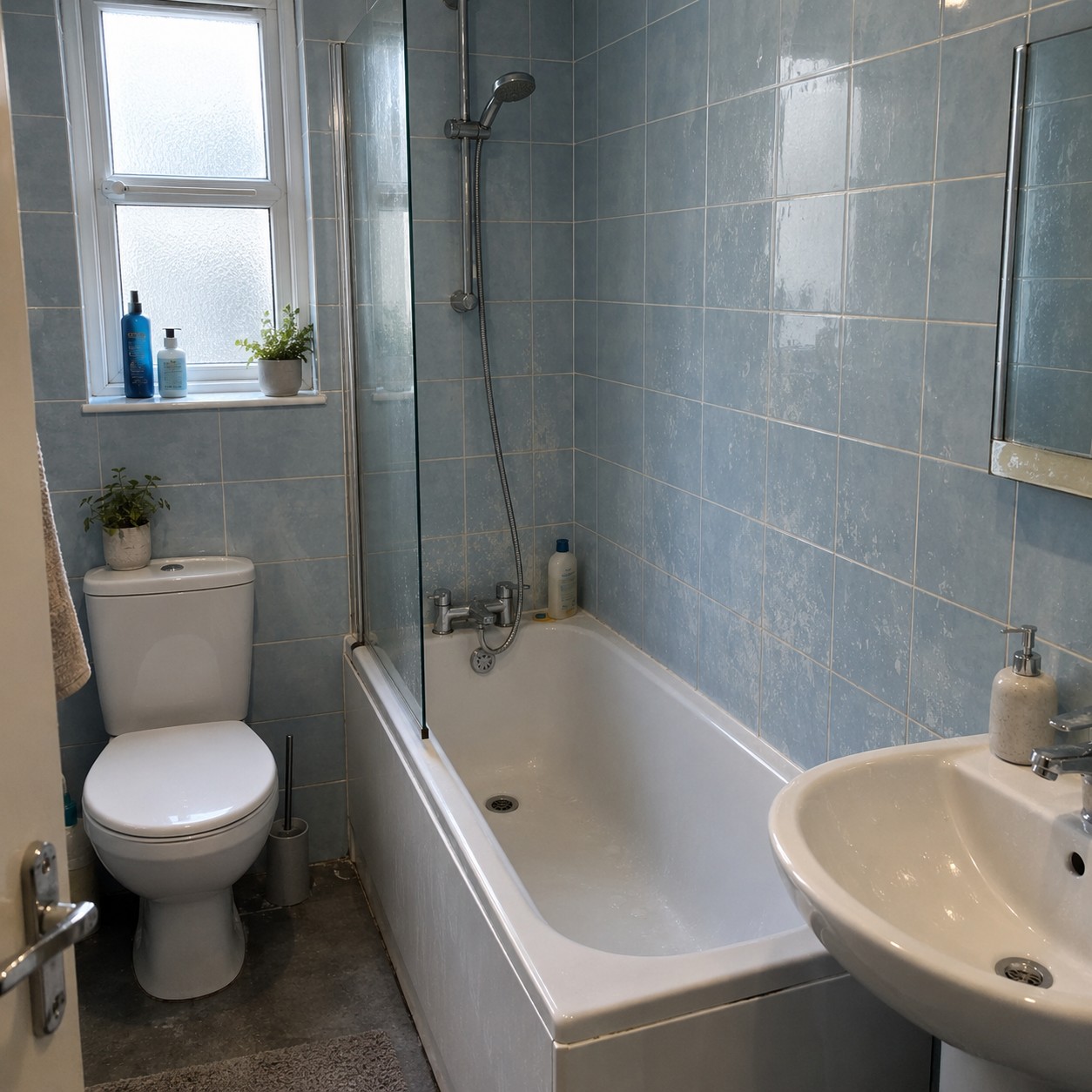
The bathroom on Fordwych Road in Cricklewood had a chalky bloom over every tile from the bath rim up to shoulder height, and the tenant had spent three weekends on it with a cream cleaner and a green scourer before she rang us. She had taken the shine off four tiles near the mixer. The bloom was still there. That is the standard outcome when someone attacks a mineral deposit with abrasion and optimism, and it happens in thousands of London bathrooms a year, because the water that comes out of the wall in most of this city is hard enough to write on glass with.
Why does London water arrive at your tiles already loaded with mineral?
Rain falls soft on the chalk of the Chilterns and the North Downs, soaks down through it, and picks up dissolved calcium and magnesium carbonate on the way. That groundwater, plus abstraction from the Thames and the Lee, feeds most of Greater London. By the time it reaches a shower head in Herne Hill or a basin tap in Pinner it can carry well over 250 milligrams of calcium carbonate per litre. Classification varies by who is printing the leaflet. The practical answer does not: it is hard, and in some outer boroughs it is very hard.
Heat it, atomise it through a shower rose, throw it at a vertical surface. The water leaves. The mineral stays behind and crystallises, and because it forms in place rather than landing as dust, it grips the glaze and the grout with something closer to a chemical bond than a smear.
What the hardness figures mean once they hit the wall
Water companies publish hardness by supply zone, and it is worth looking yours up before you buy anything. A flat in Chiswick and a flat in Orpington can be on noticeably different figures. What the number tells you in practice is dwell time – how long an acid needs to sit before the deposit gives up. On soft-ish supply you might be looking at five minutes. On a 320 mg/l zone in the far south-east, closer to twenty, with a second pass.
How do you tell limescale from soap scum, and does it matter?
It matters more than anything else in this article, because the two respond to opposite chemistry and half the failed cleaning jobs I get called into are failures of identification.
Limescale is calcium carbonate. It is white to grey, slightly translucent, and it builds in a pattern that follows water: fans of spray around the shower, tide marks at the bath waterline, a hard collar at the base of the tap. Run a fingernail across it and you feel a raised edge, like dried candle wax. Put a drop of white vinegar or lemon juice on it and watch closely – you should see a fine fizz of carbon dioxide within thirty seconds. That’s the tell.
Soap scum is a different animal entirely. Calcium and magnesium in the water react with fatty acids in soap and shower gel to produce an insoluble metallic soap, which is why bar soap in hard-water London leaves that grey-white greasy veil that traps everything else. It does not fizz. It feels waxy rather than gritty, and it smears when you wipe it – that’s the tell for scum, and it responds to an alkaline degreaser or hot water and detergent, not to acid at all.
Then there is the third thing people lump in with both: black or pink growth in the grout lines and along the silicone. Black is usually Cladosporium and its relatives feeding on the soap-scum film. Pink is Serratia marcescens, a bacterium, and it lives on the same food source. Neither is scale. Neither will shift with citric acid.
In real bathrooms you get all three layered on top of each other, which is why single-product approaches disappoint. The scum sits over the scale. Acid cannot reach the carbonate through a waxy fatty layer, so the acid appears not to work, so the customer buys a stronger acid and still gets nowhere, and eventually reaches for the scourer that killed the glaze on Fordwych Road.
The order that works
Degrease first, descale second. Hot water, a good alkaline bathroom detergent or even a diluted washing-up liquid solution, a nylon pad, and take the greasy film off. Rinse. Then apply your acid to what is left. On a shower enclosure in a serviced flat off Nine Elms Lane that we service fortnightly, that two-stage sequence takes about eleven minutes and gets glass that a single-stage attack could not reach in forty.
What shifts limescale off glazed tiles without wrecking them?
Acid, dwell time, and something to hold the acid against a vertical surface. All three, or you are wasting the afternoon.
For domestic work I use citric acid powder made up at roughly one part to ten in warm water, or white vinegar neat on lighter deposits. Warm helps – it speeds the reaction noticeably. Sulphamic acid is stronger and is what most commercial descalers are built around; it works, it is cheap, and it deserves gloves and open windows rather than casual use.
The holding problem is the one people skip. Spray goes on a wall and runs to the floor in eleven seconds, taking your dwell time with it. So we lay it on with paper towel or a cut-up microfibre pressed flat to the tile, saturate that, and leave it. Ten minutes for a domestic shower wall in a hard zone. Come back, lift the towel, work the area with a white nylon pad, and the deposit should come away as slurry. If it comes away as chalk dust instead, the towel went on too dry. That’s the tell for a bad dwell, and the fix is more liquid rather than more force.
Metal scourers, wire wool, and pumice sticks have no place on ceramic glaze, chrome, or acrylic. They will take scale off, and they will leave a matt scatter of micro-scratches that grabs mineral harder next month than it did last month.
Where acid must never go
Marble, limestone, travertine, terrazzo, and most polished concrete are calcium carbonate themselves. Put a descaler on them and you will etch a dull patch that no amount of cleaning brings back – it needs re-polishing. A lot of the newer bathrooms in Bloomsbury conversions and the Kensington rental stock are stone or stone-effect porcelain, and the two are hard to tell apart when wet. Test in the corner behind the loo.
Never combine an acidic descaler with a chlorine bleach product. Not in the same bucket, not one after the other on the same tile without a thorough rinse between. That mixture releases chlorine gas, in a small room, with the door shut. People have been hospitalised doing exactly this while trying to be thorough.
How do you get scale out of grout without scrubbing it into powder?
Cement grout is porous, mildly alkaline, and softer than everything around it. Long acid contact will erode the surface and leave you with sandy, crumbling lines – which is why I keep grout dwell shorter than tile dwell and rinse harder afterwards.
Work along the line, never across it. A stiff nylon grout brush, the narrow kind, held at a low angle, running the length of the joint. Cross-scrubbing puts pressure on the shoulders of the joint where it meets the tile edge and that is where grout fails first.
Sequence for a bad one: degrease the whole area, apply diluted acid to the joints for four or five minutes, agitate along the line, rinse thoroughly with clean water. If black staining remains after that, it was never scale, and the answer is an oxygen bleach paste – sodium percarbonate mixed to a thick slurry, left twenty minutes, brushed and rinsed. Chlorine bleach whitens the surface without killing much below it, and the growth returns in a fortnight looking exactly as it did.
When grout has gone past cleaning
Some grout is finished. If the joint is cratered, if it releases sand under a fingernail, if there are voids where a section has fallen out, no cleaning method will make it look uniform, and I will say so on the quote rather than take money for three hours of work that produces a slightly cleaner ruin. Raking out and regrouting a standard shower enclosure is a half-day job for a tiler and it resets the bathroom for a decade. Silicone the same – mouldy silicone gets cut out and replaced, never bleached repeatedly.
What stops it coming straight back in a hard-water borough?
A squeegee by the shower, used for thirty seconds after every use, does more than any product on this page. Remove the water and the mineral has nothing to precipitate from. It sounds trivial. It is the single biggest difference between the bathrooms we descale twice a year and the ones we descale every visit.
Here is the part that costs me work, and I will say it anyway: if you own your home in one of the hard boroughs and you are paying a cleaning contractor to fight scale month after month, buy a water softener instead. An ion-exchange unit fitted under the sink runs somewhere in the high hundreds to low thousands installed, plus salt. It will pay for itself against our invoices, your kettle, your washing machine element, and your combi boiler within a few years, and your tiles will stop growing a crust. Plenty in this trade would rather you did not know that. Scale removal is repeat revenue and it is dependable revenue.
What to do if the plumbing is not yours to change
Second best, if you are renting and cannot alter the plumbing: a shower head with a removable face that you can drop in a jug of citric acid solution once a month, and a bathroom that gets ventilated properly after use – extractor running fifteen minutes past the end of the shower, window open where there is one.
On the Fordwych Road flat we degreased, laid citric acid on paper towel across the whole wall, waited, and took it off in two passes. Ninety minutes for the room. The four tiles she had scoured stayed dull, and they will stay dull until someone replaces them.